

GreenEase
DIY AirCone
DIY AirCone
Couldn't load pickup availability
Share
Healthier Roots = Healthier Crops
Most hydroponic systems rely on atmospheric air for aeration.
That caps dissolved oxygen at about 8.9 mg/L — or 100% saturation.
No matter how many air stones, diffusers, or nano bubblers you add, you cannot push past that limit using air alone.
If you want higher dissolved oxygen, you must use concentrated oxygen.
This is where most systems quietly hit a ceiling.
Why This Matters More Than Most Growers Realize
At ~100% saturation, plants survive.
But many root issues don’t improve.
Pythium and other anaerobic pathogens don’t meaningfully collapse until oxygen levels are much higher.
Research and field data show real suppression doesn’t happen until ~200% saturation — roughly 15 mg/L dissolved oxygen or more.
You cannot reach that level with atmospheric air.
You must change the oxygen source.
The Missing Piece: Oxygen Concentration
Once we stopped trying to force more oxygen out of air and instead changed the source, everything changed.
Using bottled oxygen or an oxygen concentrator allows dissolved oxygen to rise beyond atmospheric limits.
That’s when we started seeing:
• Roots staying white instead of browning
• Systems staying clean longer
• Smell disappearing
• Problems stopping instead of cycling
Not because we added more products — but because the environment finally changed.
What the AirCone Does Differently
The AirCone is designed specifically to use concentrated oxygen, not air.
It raises dissolved oxygen well past 100% saturation — into ranges that air-based systems physically cannot reach.
This is why it outperforms:
• Air stones
• Diffuser hoses
• Nano bubblers
• Regenerative blowers
Those systems are all constrained by the same ceiling: the atmosphere.
Pythium Isn’t “Killed.” The Environment Stops Supporting It.
Before this, we tried everything:
❌ Hydrogen peroxide
❌ Bleach
❌ Fungicides
❌ Beneficial bacteria blends
All of it treated symptoms.
High dissolved oxygen changes the environment.
Anaerobic pathogens lose their advantage. Aerobic biology takes over. The system stabilizes instead of swinging.
Think of it like dumping massive amounts of H2O2 into the system — except it’s continuous, controlled, and doesn’t burn roots.
Why Nano Bubblers Still Fall Short
Nano bubble systems promise higher efficiency — but they don't deliver as good of results.
• More complexity
• Higher cost
• More failure points
You can’t engineer around physics.
We’ve watched $25,000 nano bubble machines get outperformed by this setup using concentrated oxygen.
That’s not marketing. That’s dissolved oxygen readings.
Build the Same System We Use in Production
This is where the DIY AirCone plans come in.
The AirCone is the opposite:
✔ Simple — almost nothing to break
✔ Affordable — parts are commodity items
✔ Serviceable — fix it yourself in minutes
✔ Energy-efficient — uses the pump you already run
AirCone Sizing
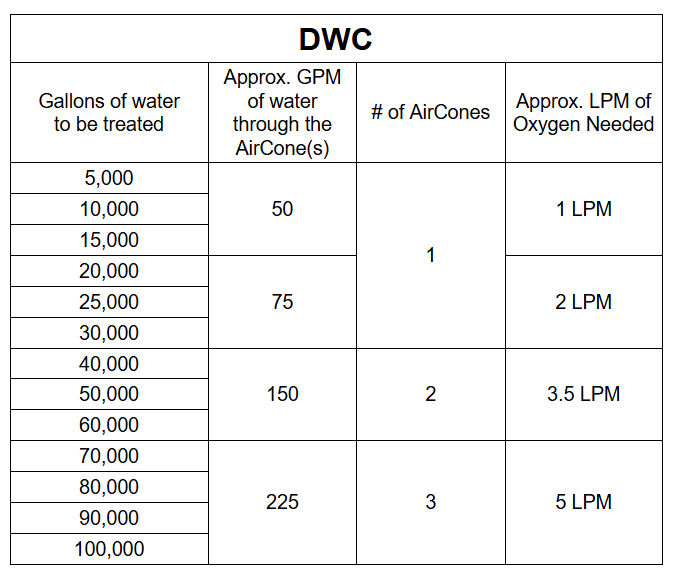
The AirCone is flexible and forgiving. The plans explain sizing, flow rates, and how to adapt the design to your system.
If you run NFT, DWC, or a reservoir, this will work.
And if you’re unsure, just email or call — we’ll point you in the right direction.
Reviews
“I just took out my Moleaer nano bubbler. All my ponds are reading 18 mg/L or above. A $25,000 machine can’t do what this setup can.”
Davin C. – Ohio
“Watching dissolved oxygen go over 9 mg/L is just as important as automating EC and pH. This fixed problems I’d been fighting for years.”
Jason U. – Iowa
“My oxygen is running 210% and 19.7 mg/L. My plants are looking very happy and my pH is finally stable”
Vaughn K. – Kansas
Made in Wyoming. Proven in Production.
This system wasn’t invented in a lab. It was built because our crops depended on it.
If you want the same oxygen levels, the same results, and the same reliability — without paying for assembly and shipping — these plans will get you there.
Buy once. Build once. Fix the root problem for good.